Send a Raven: Newsletter #19
Recommitting myself to the art of adaptation: a (beginner's) guide to surviving the SAD scaries (aka: November)

Happy November, Ravens!
So, how are we feeling this month? Excited that it’s almost December? Filled with dread as SAD season comes at us, full force? Mindblown that we’re almost at the end of the year? All of the above? Me too, let’s talk about it.
It may be no surprise to you at this point that summer is a tough time for me, but, somehow, it’s still a surprise to me. I grew up loving summer and hating winter, which subsequently meant that fall = resentment and dread, while spring = inspiration and hope. But the older I get, the more those roles seem to reverse, and it’s a phenomenon that I’m not quite sure how to lean into yet, but leaving October with a lightness that the last few months have lacked seems to be the perfect start to recommitting myself to adapting this November.
Adapting… It’s something that we all have to do—whether willingly or disdainfully, but something that I think I’ve forgotten as somebody whose experience with adaption has always been one of survival; is that adaptation is a skill, not a necessity—even if it was born from it.
And for me, it was—and for the longest time, that was something I was proud of; my ability to adapt to whatever life threw at me. But after years of carrying the weight of adaptation after adaptation, I began to resent it. I started viewing it as something I never wanted to have to do again, and I began building my life around that. But in doing so, instead of being somebody who doesn’t want to adapt, I’ve watched myself become somebody who can’t adapt. I thought I was protecting myself, but really, I was eliminating the comfort of knowing that I could handle anything—I was unknowingly putting myself into a box, and it was a box that I couldn’t see.
They say that the first step to getting to the root to any problem is acknowledging that there is a problem, but for a majority of the year, I was failing to see the problem, because I’d accomplished the goal I’d set out to achieve: I was no longer living a life that required me to constantly need to adapt. I’d done it! Great!
…not.
I’ve watched the ‘never enough’ mindset plague my generation, and though I’ve flirted with it from time to time, I’d always seen myself as relatively immune, until now. It’s something that sneaks up on you; disguised as accomplishment, but shrouded in dissatisfaction.
So, what’s the answer then? How do we see the box, so that we can step out of it?
I’m not going to pretend to know the universal solution, but what I’ve learned is that things will not become clear—especially when we’re standing so close to them—if we don’t make the room for them. And as we approach the darkest months of the year where that space seems to get even smaller, these are the things that I will be continuing to prioritize in order to keep my mind open:
Regular journalling
It doesn’t have to be daily, it doesn’t even have to be weekly, but getting your thoughts down on paper in the moment that you’re experiencing them is absolutely the tool that everybody claims it to be. There have been countless times where I’ve either worked out how I felt about something through simply writing it down, or was able to look back and see how something was effecting me in a moment where I was too close to recognize it. This method of taking yourself out of your body allows you to almost see things from another person’s perspective without having their opinion to cloud your judgment, or alter the way that you present the situation based on how you want to be perceived.
Prioritizing work
I know this one seems really simple, but as somebody who works from home 3/5 days a week for a family business, it’s really easy to get complacent (IYKYK). Though I have most of the control over my deadlines and don’t answer to a boss in a traditional way, I still have that perpetual fear of getting in trouble for not doing something right, which creates a cycle of anxiety, because I operate under my management, while not believing that management is adequate; instead of valuing the flexibility that I have, I feel like it’s wrong to use it, but that doesn’t stop me from doing so. So, in order to combat this, which has arguably been the biggest stress relief, I simply force myself to complete my tasks for work before doing anything else, and if that isn’t an option, then I set a deadline for the earliest convenience. This allows me to continue enjoying my flexibility without feeling guilty or getting overwhelmed by a backlog of unfinished tasks. This has also done wonders for my self-discipline in other areas of my life (who would’ve thought).
Timeblocking
This is another one that may seem simple, but has made a huge difference in my daily anxiety levels. When you’re an anxious, OCD, do-all-the-things kind of person like I am, it’s hard not to overlap, or feel resentment for time that gets taken up by things you may not want to be spending it on. And for the longest time I thought it was the only way—to multitask, because I just didn’t have enough hours in the day. But, as it turns out, I did, and I do, I just wasn’t organizing them in a way that was productive to my needs. And some days I really might not have enough hours to accomplish everything I want to accomplish, but those are days that I have to allow sacrifices to be made in order to achieve balance (or whatever Thanos said).
A morning routine
I know, I know, influencers everywhere are quaking. But there’s just something about perfecting your morning routine that is truly unbeatable as an adult. Where I think a lot of people struggle—including myself for the longest time—is in thinking that this routine has to follow a specific formula: waking up at 6AM, going to the gym, spending an hour getting ready for the day, cooking breakfast from scratch, etc. But I’ve learned that my morning routine is meant to set me up for success in my day, however that may look. And these days, it looks like training myself to wake up without an alarm (I’ll die on the hill that alarms are the root of all evil), wrapping myself in my heated blanket and scrolling until I’m ready to get up, making my bed (this is another broken record that is broken for a reason—an unmade bed is far too tempting), and lighting a candle (an underrated winter slap to help make your space feel warm instead of cold) before beginning my work for the day.
Hobbies
Is this a new concept? Of course not. But there is absolutely something to be said about having things to do at home that interest and excite you—especially this time of year, because it’s far too easy to give in to the rot. Not to say that hobbies need to be productive, but I’ve found that choosing solo activities that can be done alongside someone else are what help keep me from feeling like I’m just sitting around doing nothing—even if I lowkey am (ex: buddy reading—there is a level accountability that stops me from falling into a slump without the social pressure of something like a bookclub).
Leaving the house
A different side of the same coin that I find I struggle arguably the most with during the cold months. My schedule always finds itself packed to the brim during the few warm months that we get here in The Great White North, so as soon as the snow hits and forms a weeks-long alliance with 5pm darkness, making driving anywhere a minimum 20-minute preparation, the mere thought of leaving the house becomes a chore within itself. So something I want to actively try harder with this year, is not to let the weather effect the frequency in which I meet up with friends, go to restaurants, make impromptu trips to the bookstore, etc. (basically, continue living real life instead of resigning to door-front services that keep me confined to my bubble).
Going for walks (even if it’s cold)
As a Canadian, this one is hard. But when you live somewhere that forces you inside for a solid 5-6 months of the year, it’s easy to forget the importance of fresh air, which was a concept that I became reacquainted with this year, and one that I really want to push myself to continue prioritizing this winter. Not only do I very much (sometimes begrudgingly) subscribe to the idea that daily outdoor time does wonders for your mental health, I feel like it’s also just nice (and important) to break up the day-to-day monotony that can stretch weeks into months.
Keeping a clean space
This may be a no-brainer for most people, but as somebody who was raised by a type B single dad, maintaining a clean house is something that I was not only never taught, but also never experienced. Growing up, cleaning was presented as an ass-dragging, day-ruining, mammoth task where any and all corners should be cut, and that’s still a part of my brain that hasn’t quite been fully rewired yet. But, like with work, I find that any time I have any kind of unfinished tasks weighing on my mind, everything else is automatically at risk of becoming collateral damage to my overwhelmedness. So is this one much harder to get myself to do on instinct? Yes. But I always feel better once it’s done.
Eating lots of fruit
Something else that may not need to be a reminder for some, but for your fast-food-loving favorite author (me), it can be far too easy to blink and realize that I haven’t consumed any fresh anything in days—and it’s even easier when you live in the prairies where about 60% of fruit is out of season from the months of October-May. Sprinkle on a little OCD, and it can be damn near impossible to consider the juicy, tropical flavours of summer, in the dead of winter (serious question—if you live somewhere that most fruit is available year-round, do you still associate certain fruits with summer?). But I’m trying to remind myself that though my favorite fruits may not be ripe for the taking (haha) at the moment, not only do the fruits that are, taste good, they also make me feel good.
Another thing I’ve decided to take part in this month in order to keep myself productive and accountable, is NaNoWriMo!
If you have no idea what the hell that is (cue me 3 weeks ago), it stands for National Novel Writing Month (November), which boasts a challenge of writing an entire novel draft (50k words) in a month. Now, if you’re like me, you’re probably thinking that 50k words is simply just a few chapters (…I hate myself), but the purpose is to help people push through the urge to unnecessarily edit and polish things along the way, and simply just write. Make it exist, first, make it good, later—which truly couldn’t have come at a better time for me as I:
Close out the rewrite portion of ARAC #2 (draft one), and
Cower under the deadline that I’ve set for myself to finish this first draft
At first, 50k words in a month seemed incredibly daunting, especially considering that my entire draft (of strictly rewrites) was sitting at around 35k, and hadn’t moved a whole lot in the last few months. At first, I worried that the goal would be pushing myself too hard, but I wanted to accept the litmus test to see where I was at with drafting since it’s been years since I’ve been writing from scratch (minus source material lol), and the results have shocked me.
As of today, the draft now sits at a sexy lil 56k (…don’t ask me how long this one is gonna be, I don’t wanna talk about it). Stepping back into true drafting has been like putting on an old sweater that still fits (god that was cheesy), and having the challenge to push me through the urge to pour over what I’ve written so far—and, frankly, waste time—has allowed me to settle into that comfort of just letting my words take up space, and that feels good.
Something else that has helped vastly over the last month or so in my drafting, has been switching back to a good old fashioned Word document (2024 Sierra could never). Don’t ask me the science behind it, but for some reason, trying to draft in programs like Scrivener or Kindle Create stunt my progress like a motherf*.
I still like Scrivener for planning—I like having one big hub for all of my info that I can break up in a way that makes sense, and I like that I can map out my chapters and scenes and see where I want to move things. But for actually drafting, something about the set up is too busy, and I get too easily distracted or thrown off course. So, instead of swimming against the current, I’m allowing myself to go with the flow, and, (un)surprisingly, it’s working.
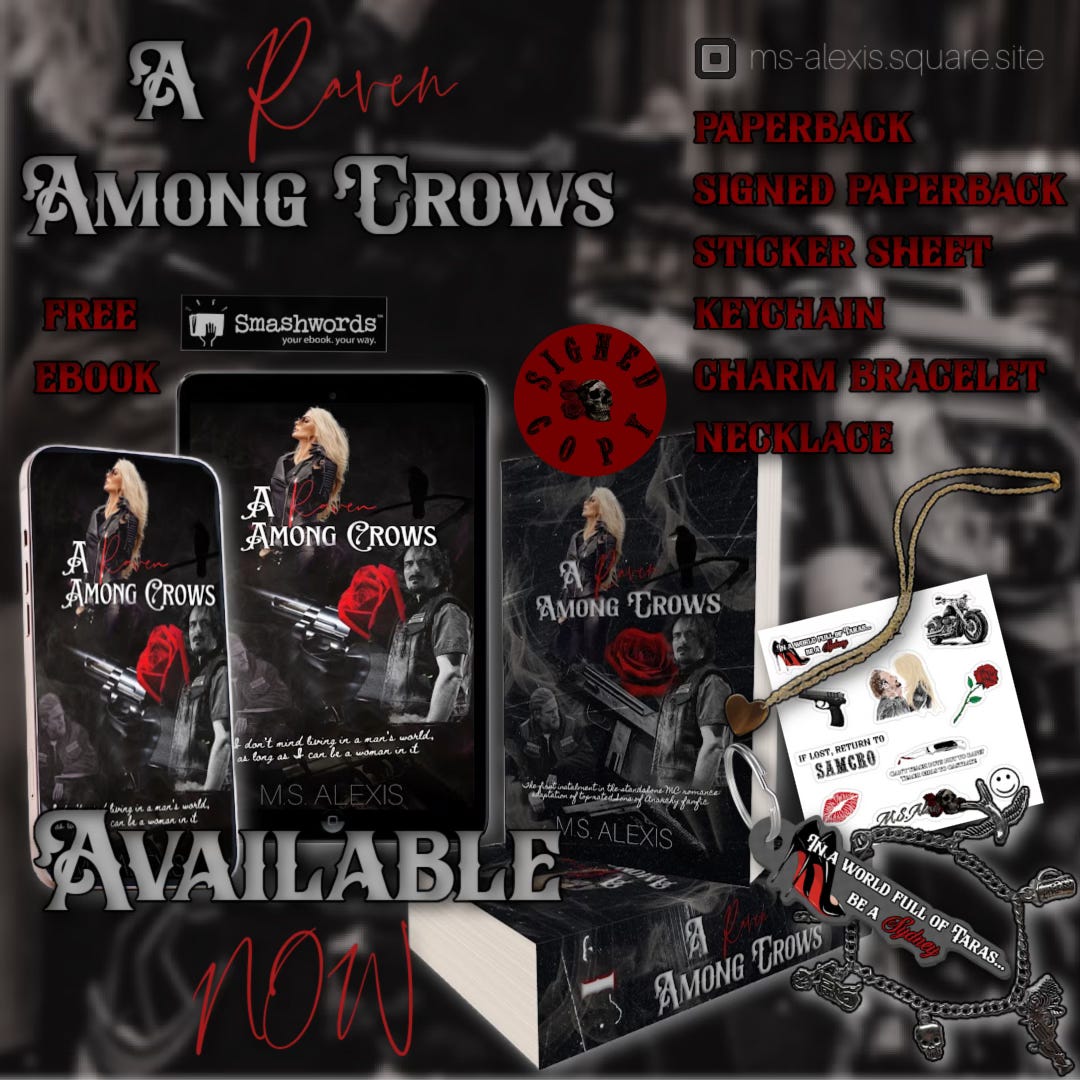
It has been brought to my attention that some of you may be holding out on ordering due to shipping costs (which, trust me, I get it 🙃). I have a little loophole that may help you out:
Shipping prices vary both by location, and by item. If you’re looking to order a signed paperback or any merch, these are items that are shipped directly by me from Canada, and those are (crazy) costs that I unfortunately cannot avoid. BUT, if you live in USA, UK, AUS, NZ, Europe, etc. (basically anywhere but Canada lol) and you place an order for the regular paperback, shipping is significantly cheaper, as I am able to place the order directly to the distributor within your region and have them ship it to you. So if you were hoping for a signed copy and freaked out at that disgusting $30 shipping charge, but you still want a paperback, check out those shipping rates! And don’t forget to use code BONESTOPICK at checkout for an extra 10% off.
Now, with all the exciting talk of ARAC #2, I couldn’t skip other this month’s features, especially because our November birth chart spotlight is none other than the man, the myth, the legend, himself…
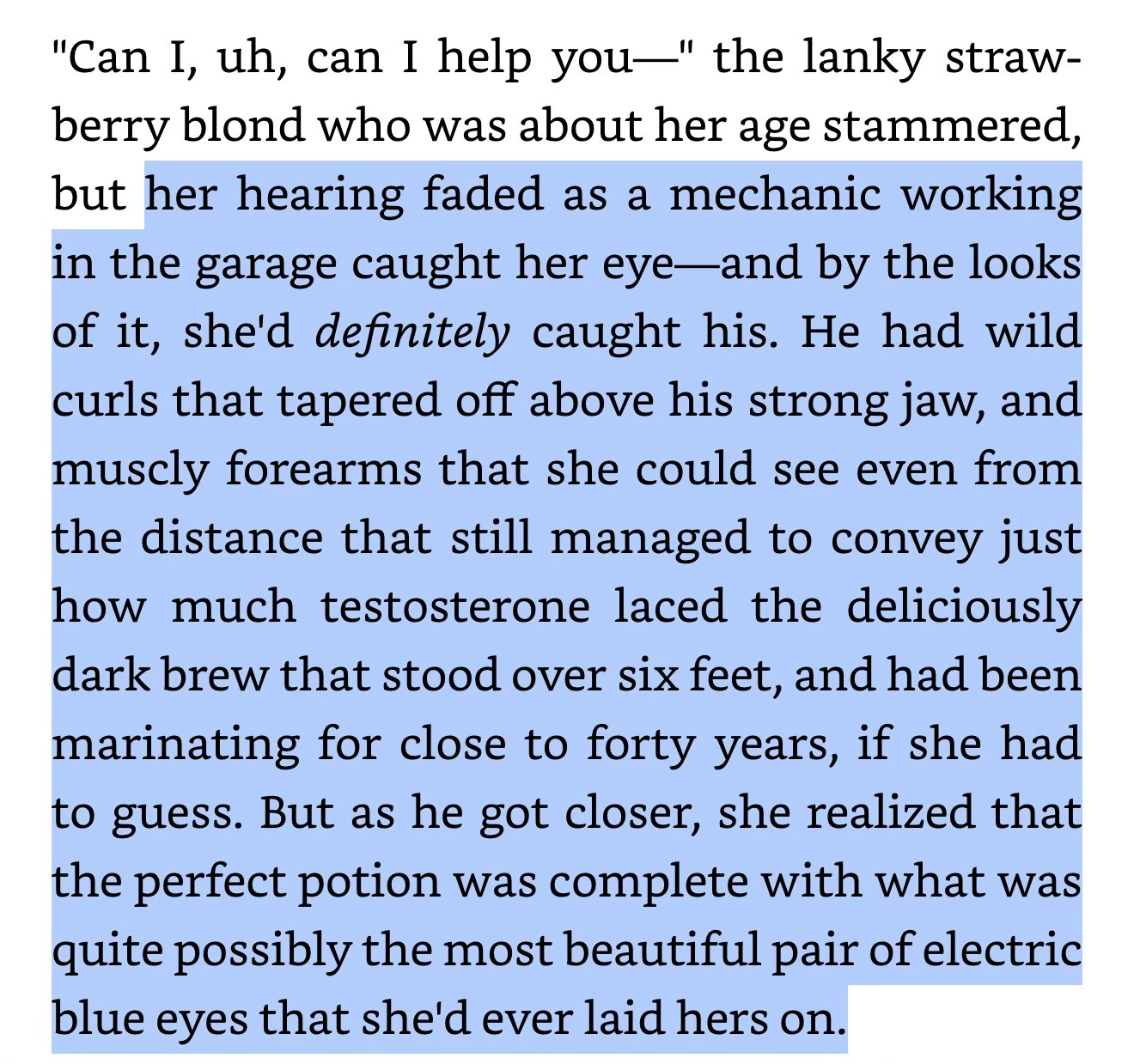


That’s right, ladies and gentlemen, today we are going to be scrutinizing the birth chart of our leading man, Alexander ‘Tig’ Trager (or Sergeant, if you’re nasty—or Sydney), born November 29, 1965 at 9:16 P.M. in Oakland, California to Irene and Frank Trager.
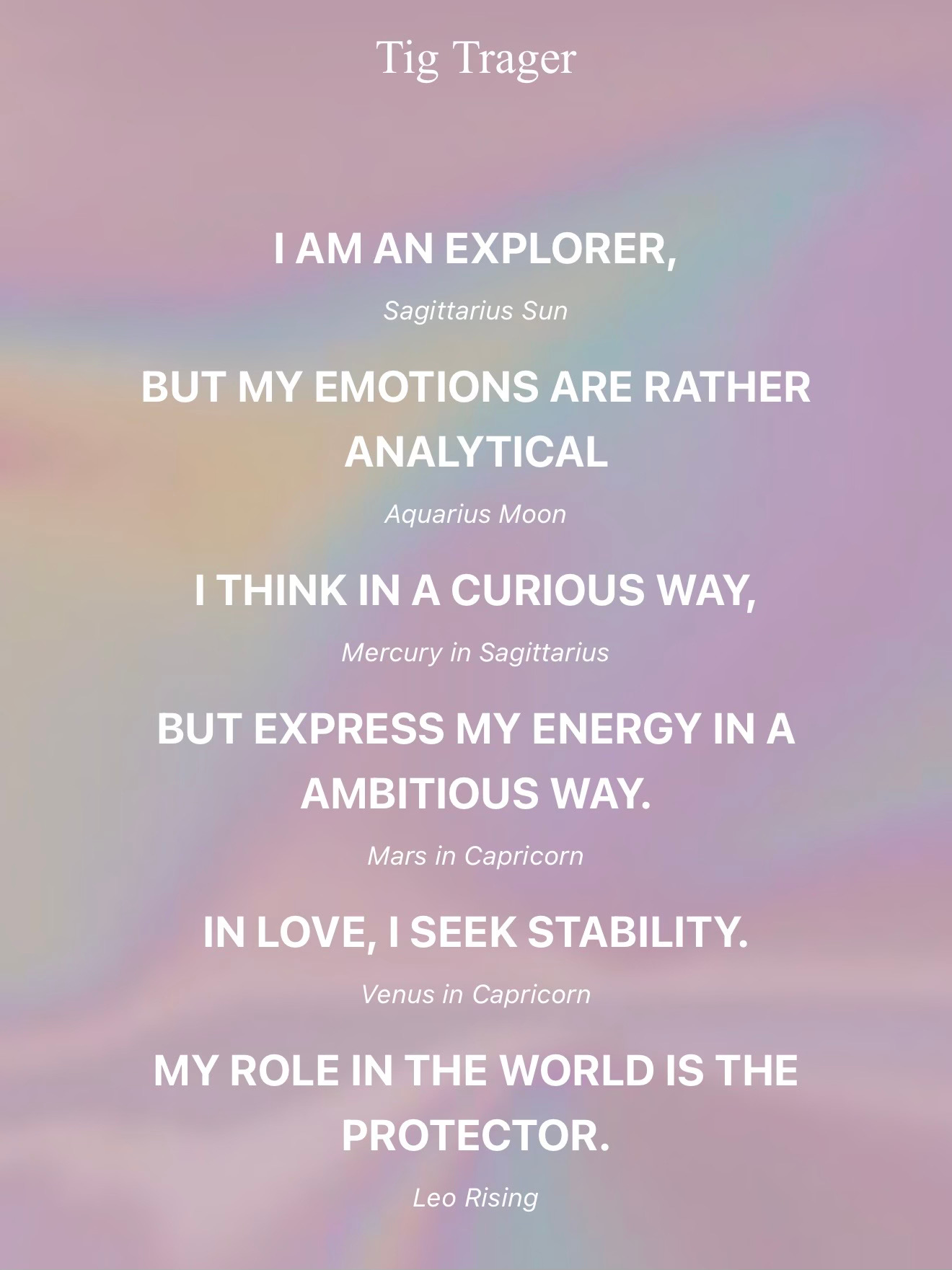
Now, when I first began concocting Tig’s birth chart (and when I say concocting, I mean deciding that he’s a Sagittarius and picking a day that feels right), I was pleasantly surprised that the first day my intuition picked have him a chart that matched up to Sydney’s almost perfectly—but the one thing I couldn’t settle on, was the moon. The first time I chose gave him a Pisces moon (like Sydney, but y’all gotta wait for April to see her full chart), which felt right at the moment because I very much see Pisces as the tortured souls that are Tig Trager (especially in book 2👀). But since he and Sydney did have such similar charts, it made me question my first choice, but though they have many similarities, they also have differences. So though the description for an Aquarius moon doesn’t exactly describe Tig (don’t we know it), the way I interpret this difference is within their internal reactions to things—which is what the moon is all about. Sydney will feel things, but she won’t show them, which for me felt on brand enough with a pisces moon. But for Tig, he almost has to force himself not to feel these things rather than just not showing that he does, which is where I feel the aloofness of an Aquarius comes in. Aside from that, his chart being all fire and earth—reactivity and stubbornness—is nothing I think anyone will dispute. And for the Sergeant to have the role of the protector? I mean, come on… But, you know who else has the role of the protector? Our good Deputy… So what happens when two people opt to serve and protect, but their ideas of service and protection look completely different?
Had time to think about that? Good! Let’s discuss…
📣📣ARAC #1 SPOILERS AHEAD. PROCEED WITH CAUTION📣📣
What is Hale’s role in ARAC #2?
Our poor, poor Deputy that I have developed far too soft of a spot for is going to experience a brutal full circle moment of failure this time around. Something we learn in book 2 is that Hale’s main goal isn’t just to protect the citizens of Charming, but moreover to protect women from gang violence (and you’ll just have to wait to find out why👀). So following Donna’s death, he’s struggling to recover from not only the failure, but for failing somebody that he knew personally. He’s also struggling with where to place the blame, because though he feels guilty, he knows that her death wasn’t a direct result of his actions—especially actions that he tried to reverse. So, with Stahl gone (…for now), the only face he has left to put to the crime is SAMCRO, and inadvertently, Sydney—which is a whole ‘nother can of worms. I think that he wants to double down and make them pay for not only the hit to his community, but also his ego, but he knows in his heart that they aren’t completely at fault either. It starts a push and pull within himself that not only has him unable to recover from the failure of his first priority, but in trying to do so, he loses sight of his second: being a good cop.
Okay, you’re safe. As you were…
Now, with all that talk about book 2… I think it’s time we take a look at what we’re in for, don’t you?

The first official teaser for A Raven Among Crows ll: Tainted With Blood and Smoke